Monday, November 21, 2022

Next Week and the Final Exam Assignment (due Dec.9th!)

If you missed class on Monday, or simply forgot what we did, remember that I gave you a Final Exam assignment (posted below). It's based on the idea of making Shakespeare new again, and challenging how we see and understand his plays. It's also inspired from the Reduced Shakespeare Company, a performing troupe which used to perform all of his plays in about an hour and a half. The video below is what we watched in class (about the first 26 minutes), but feel free to watch the entire thing for inspiration. 

ALSO, we DO have class next week, but only on MONDAY. We're going to wrap up the course and get the chance to win valuable Shakespeare prizes! :) Enjoy the break and I'll see you next week. 

Link to the Performance: 

English 3213: Shakespeare

Final Project: Ten-Minute Shakespeare

For your ‘final exam’ so to speak, I want you to take a cue from The Reduced Shakespeare Company, which performed all 36 of Shakespeare’s plays in a single hour (well, sort of). While this is a humorous idea, it also tests how well you know a given play, and what the essence of the play’s themes and ideas truly consist of. What would a ten-minute Julius Caesar or Hamlet look like? How could you compress most of the general theme, plot, and ideas into a single short scene?

That’s exactly what I want you to do: take one of the plays from class, and reduce it to a 5-7 page script (since 1 page = 2 minutes of reading time). You don’t have to write a thing. All you have to do is arrange lines of dialogue that somehow suggest the main action, events, or ideas of the play. Granted, you’re going to have to leave a LOT out. But how can you still suggest the basic essence of the play to an audience so that they walk away with a rough idea of what the play is about (or maybe, some aspect of the play)?

Think of the 10-minute scene as a kind of ‘movie trailer’ for the play, one that captures the drama of the work in miniature. You don’t have to use an entire speech, or an entire conversation, but edit it as you see fit. For example, you could focus solely on the journey of a single character, or a single theme, or a single relationship. Or you can give several little snapshots. But try to make it coherent, and include stage directions (the original or your own) so we see how the different moments go together.

The goal of this assignment is for you to communicate a ‘reading’ of the play based on the shortest possible script of the play. Have fun with this. It doesn’t have to be serious: in fact, you can show us how silly King Lear looks by only focusing on the ‘mad’ parts! But think about your audience: assume they’ve never seen the play before, so try to give them a taste of what they’ll encounter when they see or read a complete performance. Or better yet, make them want to see it!

REQUIREMENTS

  • Try to keep it short, no more than 5-7 double-spaced pages. After that you’re cheating! :) 
  • Make sure we know who’s talking and where they are. Use stage directions as you see fit, and feel free to add your own (that’s the only writing you’ll have to do)
  • Maintain the play format, so that it reads like an actual scene in a Shakespeare play.
  • Feel free to add your own scholarly footnotes ala the Folger Shakespeare! (especially if you want to be funny)
  • DUE NO LATER THAN FRIDAY, DECEMBER 9th BY 5PM

Wednesday, November 16, 2022

For Friday: Shakespeare, Measure for Measure, Act 5


Remember, we'll do an in-class writing over Act 5 on Friday, so I won't post questions after class. The questions below, as always, are about today's reading and discussion (Wednesday).

Answer two of the following:

Q1: Though we have no idea what Shakespeare really intended with this play, when it was first published in the Folio of his completed works, Measure for Measure was listed as a comedy. Why do you think this is, based on our reading so far? Does it suggest a certain dark humor in the play? Or a sense that we shouldn't take the moral implications and "dark corners" of the play too seriously? Or does the play offer the laughter of a Fool, who tells us the truth while seeming to be absurd?

Q2: Why do you think Isabella, who defies both her brother and Angelo, is so compliant to the Duke's wishes? Consider that even after she learns that Claudio has been killed, and the Duke tells her to keep up the facade, she replies, "I am directed by you" (4.3). Why would she be directed by him, a random Friar who has a dubious plan that seemingly fails to work?

Q3: What role does Lucio seem to perform in this play? He's a totally inconsequential character, and yet, as he tells the Duke, "I am a kind of burr; I shall stick" (4.3). Why do you think Shakespeare found his character attractive?

Q4: We discussed the Duke's connection between both King Lear and Hamlet in class today, which brings up a big point: do you think the Duke is mad? Angelo certainly thinks so, saying that "His actions show much like to madness" (4.4). Is there more method or madness in his actions so far? Does he seem to have a calculated, long-term plan? Or is he just making this up and he goes?


Monday, November 14, 2022

For Wednesday: Shakespeare, Measure for Measure, Act 4


Read Act 4 for Wednesday, and answer two of the following based on Monday's reading/questions:

Q1: What do you make of the strange scene in Act 3.2, when Lucio confronts the Duke-Friar and gossips about the former Duke, saying, among other things, that "He had some feeling of the sport, he knew the service, and that instructed him to mercy" (119)? Is he merely lying to make everyone seem as bad as he is, or is ironically telling the truth to the Duke's face? How does the Duke react to this information? 

Q2: A great point was made in class that Isabella's outrage in 3.1 against her brother is because he would never have to sacrifice himself to save her, yet she is asked to do the one thing she most abhors to save him. Is that how you read this scene? And if this is true, why doesn't she say words to this effect, instead of just insulting him and calling him a "faithless coward" and a "dishonest wretch"? Are we supposed to be more sympathetic with her in this scene, or with Claudio?

Q3: Why do you think the Duke is getting so involved in the intrigues of his kingdom rather than simply curing them himself? For example, he cautions Claudio to prepare himself for death when he, more than anyone, could save him with a word. And why does he offer the example of the bed-trick to Isabella, rather than simply pardoning them both at once? In short, why not see that Angelo screwed up and call it off...why does he continue to play the game?

Q4: When Angelo presses Isabella to accept his terms, she protests, "Better it were a brother died at once/Than that a sister, by redeeming him,/Should die forever" (83). Do you think she really believes that God's judgement would be so inflexible when she later told Angelo to forgive her own brother's sin? Is she being a hypocrite as much as Angelo, though to a less disgusting degree? 


Wednesday, November 9, 2022

For Monday: Shakespeare, Measure for Measure Act 2.3-Act 3 (see note below)


NOTE: These are the post-reading questions for Wednesday's class. You can turn these in as late as MONDAY, since we don't have class on Friday (Paper #3 is due on Friday, remember). But be sure to read Act 2.3-Act 3 for Monday's class as well.

Answer two of the following for Wednesday's reading:

Q1: What is the purpose of Act 2.1, which is little more than an elaborate farce between Elbow, Escalus, and Pompey? Do we ever learn what Escalus accuses Pompey of doing to his wife? How does this all relate to the rest of the play?

Q2:  We briefly discussed Isabella's powerful speech in Act 2.2, where she proclaims that if everyone used their power like Jove, "Jove would never be quiet,/For every pelting, petty officer/Would use his heaven for thunder,/Nothing but thunder" (67). According to her, what is the danger of punshing people within the full limits of the laws, as many judges do even today? Why not give someone the maximum sentence, if the point of a punishment is more to deter crime than than to punish the person themselves?

Q3: It was mentioned in class today that the play has resonances with the Book of Job, where God tests his most faithful servant to show Satan that some men are indeed true to the faith. How might this play be a kind of allegory for faith or virtue, and if so, who do you think is being tested: Angelo, or Isabella? Who might be the real protagonist of this play?

Q4: Re-read Angelo's famous soliloquy in Act 2.2, where he reflects on the effect that Isabella has had on him. What do you think he means when he says, "but it is I/That, lying by the violet in the sun,/Do as the carrion does, not as the flower,/Corrupt with virtuous season" (71)? Why is he not like the flower, and why is he doing "as the carrion does"? Does he think himself unfairly "assayed" by Isabella in this speech, or is he admitting to his own weakness and frailty? How well does he seem to know himself here (consider how Lear's daughters said "he does but slenderly know himself"). 

Saturday, November 5, 2022

For Wednesday: Shakespeare, Measure for Measure, Acts 1 through 2.2


NOTE: Be sure to read past Act 1 through Act 2.2 since Act 1 is very short in this play, and a better cut-off point is Act 2.2.

Since we couldn't watch Act 1 in class today (!!), here are some notes that might help you in your reading of the play. Also note the scene summaries at the beginning each scene in the Folder edition of the play--they can be very helpful!

Act 1.1: The DUKE is giving his power to ANGELO to see if he can tame the people's taste for vice and debauchery, which has gotten out of hand. He thinks it's unfair to suddenly introduce harsh laws since he more or less let such behavior flourish under his reign. ESCALUS is his second-in-command who learns about this first, and is told to assist Angelo.

Act 1.2: LUCIO is a man-about-town and a friend to CLAUDIO. He learns that the brothels are being closed and anyone who commits a sin, such as sex before marriage, will be punished severely. Claudio has been accused of just such a crime, since he slept with his fiancee, JULIET, out of wedlock. He speaks with Claudio on the way to prison, and Claudio entreats him to talk to his sister, ISABELLA, before she takes holy orders as a nun. If anyone can convince Angelo to save his life, she can.

Act 1.3: the DUKE talks with FRIAR THOMAS, who helps him disguise himself as a fellow brother. The Duke explains why he has skipped out of town, only to return secretly to watch Angelo's affairs. He believes that Angelo is an extremely virtuous man who might, if possible, be too virtuous. So he wants to test him. 

Act 1.4: Lucio convinces Isabella to entreat Angelo to save her brother's life. 

Act 2.1: A long, 'comic' scene, where Angelo and Escalus hear the testimony of ELBOW, an officer, against FROTH and POMPEY. Elbow has the very comic ailment known as "malapropism," which means when a character uses a negative word for a positive meaning. For example, he often calls his superiors "vagrants," and calls the criminals "benefactors" (instead of malefactors). He goes on and on and doesn't make a very convincing case against the pair, whom he thinks have debauched his wife (which they don't exactly deny). Escalus finally sends him away with not much accomplished.

Act 2.2: The 'big' scene where Isabella petitions Angelo, at first unsucessfully, but gradually more and more persuasively until he relents--almost. He tells her to come back tomorrow, and then has a soliloquy which shows how attracted he is to her 'virtue.' Note Isabella's language in this scene, which is extraordinarily powerful and some of Shakespeare's greatest writing. She clearly blows him out of the water. 

REMEMBER: No questions until after class on Wednesday. Then I'll give you "post reading/discussion questions," and you can answer them anytime between Wednesday and Friday. This way, you can focus on reading and not have to scramble to finish the questions right after class. Remember, too, that Paper #3 is due on Friday! 

See you next week! 

Friday, October 28, 2022

For Wednesday: Shakespeare, King Lear, Acts 4 & 5 (see note)


NOTE: Remember, no class on Monday, since I have a schedule conflict that I can't avoid. We'll pick up King Lear on Wednesday. In the meantime, finish the play and answer two of the following questions...

Q1: In the early acts of the play, both Lear and Gloucester seem to believe in the power of fate and the gods to order the universe and dispense justice. As Gloucester proclaims before his eyes are put out in Act 3, "But I shall see/The winged vengeance overtake such children" (163). How do one or both men's views of fate/justice as the play reaches its conclusion? Do they feel that the gods are still watching over them, ready to offer justice? Or are we performing alone on-stage, without even an audience?

Q2: Why does Edgar pretend to lead his father to the edge of a cliff to watch him 'jump' in Act 4, scene 6? Is this an act of madness on his part? Is he being cruel/getting revenge? Or does he have another method to his 'madness'? Is this another scene that could/should be played for laughs?

Q3: As the most self-aware and rational/cynical person in the play, what is Edmund's endgame in Act 5? What does he hope to achieve by courting both sisters and plotting against Albany? Do you feel these plans are more active (a creation of his own nature) or passage (a reaction to the actions around him)? 

Q4: Did it surprise you that despite her very active beginning, Cordelia ends up a passive spectator in Acts 4-5, only to die off-stage? Why might the play have silenced and defeated her, letting Edgar be the true victor/survivor of the play?

Q5: What do you think happens to the Fool? Why does he disappear in 3.6 never to return? Is he killed? Does he run away? Is he simply no longer needed since Lear is 'cured'? (note that many staged versions show him being killed in some manner). Similarly, why does Cordelia only return to the play once he's gone? And why does Lear call Cordelia his "poor fool" at the end of Act 5? Is he confused about who she is...or he is remembering what happened to the fool off-stage at some point? (or do we buy the footnote that a 'fool' is merely an endearing term for a child?) 

Paper #3 assignment: The Role of Madness, due Nov.11th


Englis
h 3213

Paper #3: The Role of Madness

“We do and are done to, endlessly, neither pure agents nor victims. We live in the active and passive ‘voice,’ to use the grammatical term. There are other kinds of doubleness to the ways we live in time, in several tenses and moods all at once, in our sense of what was and will be, what should be and might have been, as well as what is” (Poole 99).

In both Hamlet and King Lear, people are constantly ‘playing mad’ or ‘playing the fool,’ or otherwise acting roles that are outside their normal (or society’s) character. However, we only see this in upper-class characters such as Hamlet, King Lear, Kent, Edgar, and Ophelia. While each one of these characters is clearly a victim and nursing some private hurt, they also lash out at others through their madness, becoming perpetrators themselves. Indeed, they often threaten, wound, and even kill in this new identity. So why is madness the only way in Shakespeare’s plays to usurp your given role in society? Why can’t Hamlet act, for example, without going mad?

Some things to consider:

  • When do characters go ‘mad’ in the play? Is it sudden? A process? Is it announced? Does everyone do it the same way?
  • What happens when two ‘mad’ characters confront one another?
  • How does language determine who is mad and who is acting?
  • Is madness itself active or passive? How do we know?
  • Is madness the ‘real’ person inside the mask? Which one is the alter ego, the original character or the mad one? Which one seems more natural?
  • Are the Fools in these plays ‘mad’? Is madness a way to speak secret wisdom? Is it a code?
  • Is anyone cured of their madness? Is it permanent or temporary? Are the characters in command of this role—or does it command them?

REQUIREMENTS

  • Discuss at least TWO characters, though you can focus more on one than another. But you’ll need more than one to really establish some of your ideas about madness.
  • QUOTE from the plays and examine the language, since character is a performance, and the performance occurs through language.
  • Be sure to cite all quotations with the page number or the act/scene number.
  • No page limit, but please double space! I also prefer Word docs, even pasted in the e-mail, rather than a PDF if possible.
  • DUE Friday, November 11th by 5pm [no class that day]

Wednesday, October 26, 2022

For Friday: Shakespeare, King Lear, Act 3

 REMEMBER, no questions this time! But read Act 3, since we'll do an in-class writing when you get here to discuss some aspect of our reading. So bring your book! See you then...

Monday, October 24, 2022

For Wednesday: Shakespeare, King Lear, Act 2


 Answer two of the following: 

Q1: In a play about nature/natural vs. unnatural/nothing, why are so many people acting and/or playing roles? Besides the Fool, both Kent and Edgar take up disguises as madmen/fools, and even Lear, to some extent, is playing a role (since he’s no longer the king). Why do you think Shakespeare has so many characters switching identities merely to perform before one another?

Q2: In some ways, Lear’s response to his daughters is similar to Hamlet’s response to his mother, as both use terms such as “adulterous” and “incestuous” to describe rather normal situations (a mother falling in love again, daughters rebelling against their father’s whims). Why does he find their behavior so unnatural, especially since he exclaims to Regan in 2.4, “I gave you all” (115). What does he feel he has given them—love? Land? Life?

Q3: Somewhat related to Q2, why does Lear insist on maintaining his knights even when he’s no longer king? When asked why he needs 25, 10, 5, or even 1 knight, he thunders, “O, reason not the need!” (117). Why might this speech in 2.4 shift Lear from being a rather flat, antagonistic character to someone more round and compelling? Is this the moment Lear becomes a more sympathetic character to you?

Q4: Act 2.2 is a strange scene, where Kent goes after Oswald like a man out for revenge. He not only viciously berates him (pp.83-85), but attacks him and seems on the verge of killing him. Since this scene almost comes out of nowhere, is this scene supposed to be played for laughs? Is Kent just acting mad here for the audiences’ entertainment? And if so, why does Regan punish him so severely?

Friday, October 21, 2022

For Monday: Shakespeare, King Lear, Act 1


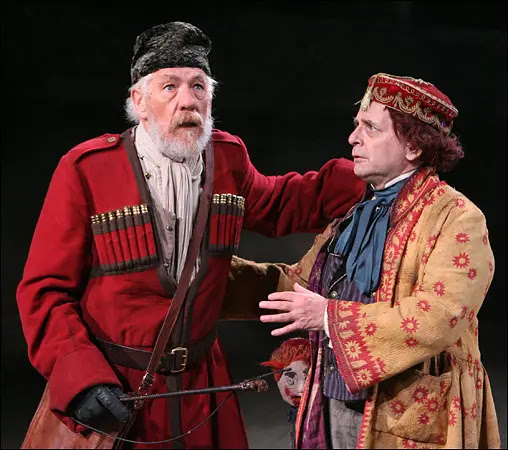
On Friday, we watched Act 1 from Trevor Nunn's 2008 film (based on his 2007 production) of King Lear starring Sir Ian McKellan. If you want to learn more about this production, or about Lear in general, here's a great article/interview about it: https://www.rsc.org.uk/king-lear/past-productions/trevor-nunn-2007-production

For Monday's class, be sure to read Act 1 of King Lear and answer two of the following questions:

Q1: As always after we watch a production, is there anything that you saw in the lines that you didn't necessarily see on screen? OR, did the staged version help you see something--an interpretation, reading, staging, etc.--that you wouldn't have noticed from the text itself? 

Q2: Why does Cordelia refuse to tell her father how much she loves her, when it seems clear she actually does (as opposed to her sisters, who seem pretty damn tired of him!)? In the play, she has the aside (not shown in the production) where she says to herself, "What shall Cordelia speak? Love, and be silent" (11). Does her silence show love? Is that what "nothing, my lord" is supposed to convey? 

Q3: Edmund makes two speeches in Act 1, scene 2, the first in verse, the second in prose. Both speeches are "asides" to the audience alone, and so show something 'naked' about his true character and motives. What does one (or both) of these speeches reveal about him as a character? For example, what might he mean when he says in the first speech, "Thou, Nature, art my goddess" (29)? 

Q4: For the first time in this class, we have a true Fool in the play, who plays a very specific role with Lear: he entertains him by speaking a witty form of the truth. What is he trying to tell Lear through his jokes and banter? Does Lear seem to catch his meaning, or does he dismiss it as mere nonsense and buffoonery? 

Thursday, October 13, 2022

For Wednesday (see note below): Poole, Chapter 8, "Timing"


NOTE: No class on Monday. I have to cancel--check your e-mail for details. We'll pick up the reading and questions below for Wednesday. 

For next week, after Fall Break, be sure to read Chapter 8 of Poole, "Timing" to dovetail with our discussion last time of Hamlet, Act 5. We'll return to some ideas in Act 5 a well. Enjoy the break! 

Answer two of the following: 

Q1: Poole writes that “it’s all in the timing” (97). Why is timing particularly important for tragedy, particularly for at what moment a tragedy begins? With Hamlet, why don’t we begin with the murder of the king? Or much later? After all, couldn’t the entire Act 5 be the play itself?

Q2: Poole notes that the word crisis comes from the Greek word for "justice," and climax comes from the Greek word for "ladder" (102). Why might tragedy then suggest that you need to climb to the top of the ladder to find justice? How might this explain the events of Hamlet? What 'climax' do we have to reach (and on how many rungs?) to achieve justice? And what kind of justice is it?

Q3: Poole reminds us that tragedies are about rites of passage, and specifically, rites such as weddings, coronations, death, funerals, etc. He goes on to note that "These things can go wrong. And tragedy represents the moments when they do, when the rites are challenged, thwarted, violated, aborted" (107). How is Hamlet a tragedy about aborted/thwarted rites? What rites? And how do they go wrong? Whose fault is it that the rites don't work as planned? 

Q4: Quoting the critic Gail Holst-Warhaft (what a name!), Poole notes that tragedy “is, at least in part, an appropriation of the traditional art of women and we sense in its language, its inscrutable echoes of music and dance, an older body of ritual, a sub-stratum which informs and at times intrudes itself into an urban, male art” (106). What do you think she means that tragedy combines the female art of lamentation (since women traditionally were mourners of the dead) with the male art of war/action?

Link to my Cleopatra article, "Cleopatra, Content Queen: Shakespeare's Viral Monarch in Antony and Cleopatra"

For those interested, the class inspired me to write a shortish article on Cleopatra as the first "content queen," or a proto-infl...